Showing posts with label Battletech. Show all posts

Tuesday, February 4, 2014

The Making of a Model Part 2
The Making of a Model Part 2


Okay, I left off yesterday with the shoulders, and lets just jump right into it.

First off, we are going to make a quick circular sketch on the right side flat part.  Like so:


We extrude it out, and lets see how it looks:
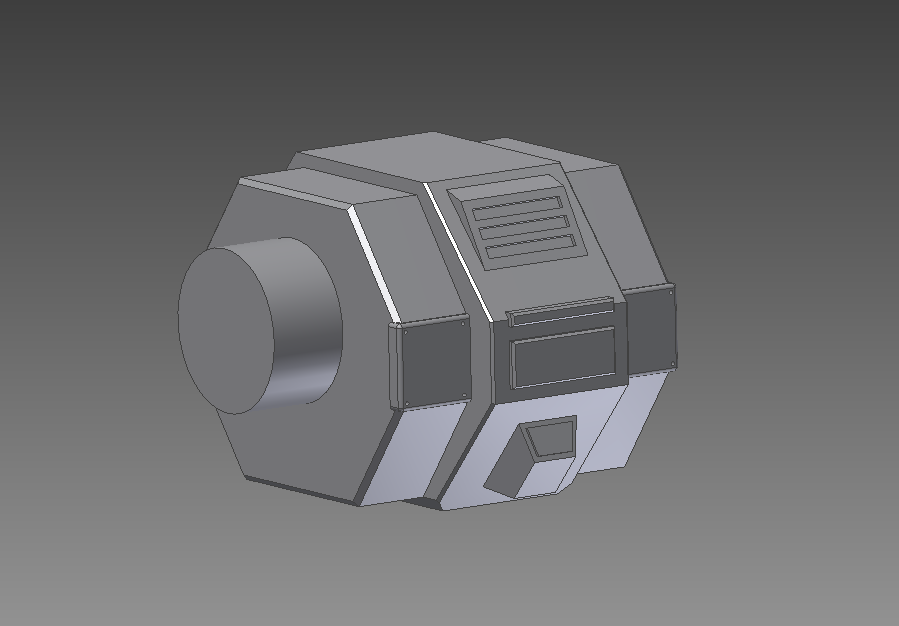


It looks good.  Now lets cut some grooves into that circle to give the appearance of that armored look, with several panels like it has.  We’ll do 12 panels, to make it look like the art, but we may need to adjust later.

First, the sketch:


Then the groove:


Then the rotational pattern to make 12 of them:


Looking good.  We’ll need to make a few detail oriented changes to match the art.  I won’t go in depth on these, as it will take me 200 words to go over something that won’t seem to make much of a difference.

The real key is though, that these small differences are still important.  It is the small details that make a good model a great model.  That will make something worthy of a 3D printer.  So take a look at my changes:


These small changes add realism to the model that wasn’t there before.  The corners of each armor panel are now rounded, while the edges are now slanted over (chamfer, for those who know CAD).  I bumped out the center the shoulder slightly to accommodate better joint with the arm.

Now I am going to make the shoulder cowl, and we will begin on the laser mount above it.  I switch to wireframe view to get a better view of what is going on.


From there, I extrude, about 2.5mm, where the whole shoulder assembly was about 3mm.  This leaves just a little of those armor plates exposed, giving some nice detail.
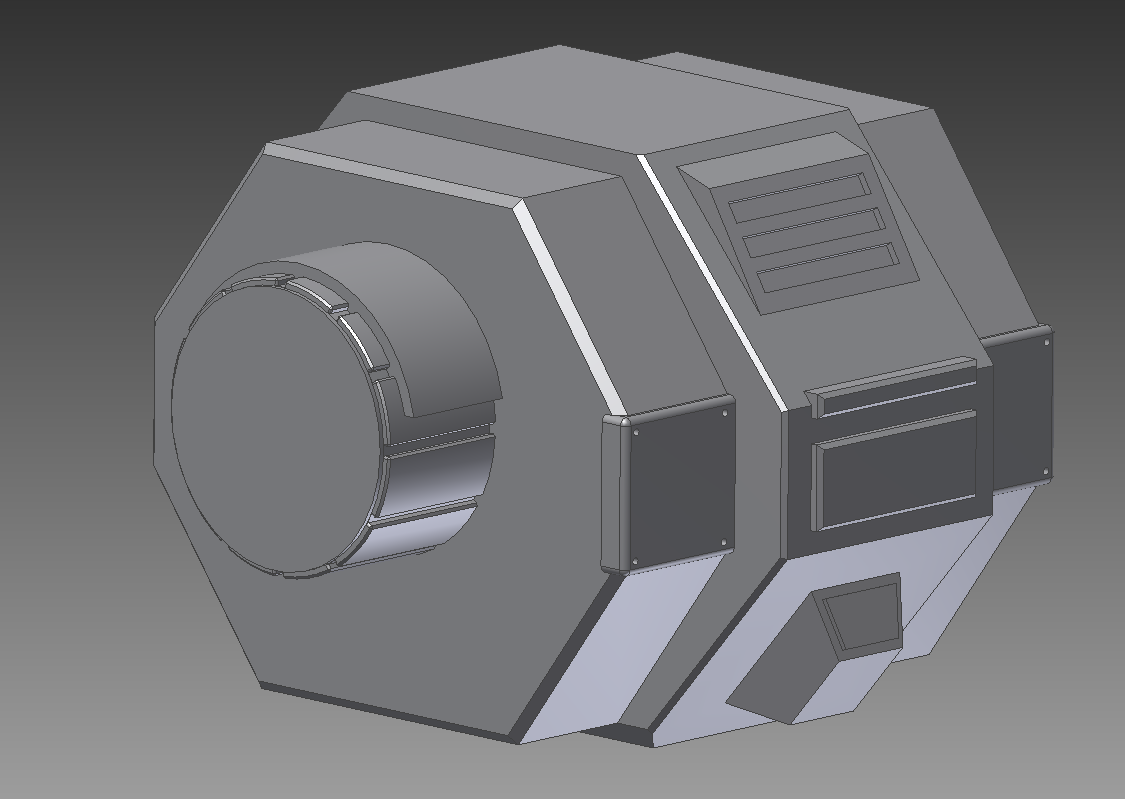


Lastly, I round over the corners and the edges to match the artwork.


Next, it is time to work on those shoulder lasers.  Each shoulder has a medium laser on top of it, with a housing around it and a lens in the middle.  These are going to be a little tough to model, but if I use one of the origin planes to create the housing, it shouldn’t be too tough.
First, the sketch:


Then the extrusion:


And finally, the details which would have taken too long to explain:


Now, I am going to try and add some details which were not immediately visible in the original art, but may add some more character and “roboticness” to the ‘Mech.  I am going to try and add power cables to the back of the lasers.  I am not going to explain what I am going to do, I am just going to do it, and I’ll explain after pictures:


That turned out much better than expected.  We could call this section the power coupling and cooling jacket for the laser.  Either way, it adds a nice bit of detail where there really wasn’t any of the original picture.  A glance at the back of the original Dark Age miniature doesn’t have this, but I think it adds something to the ‘Mech, so I am going to leave it.


I think that is all I am going to blog about today.  I will be making a few more additions along with some detail for the back, and we’ll get to the head and missile launcher tomorrow!

Monday, February 3, 2014

The Making of a Model Part 1

Okay, so I am going to try and post about modeling in CAD and maybe give a step-by-step on how I did it.

This is going to be a bit over-detailed, but I will get less detailed as steps continue and my thought processes become more transparent.

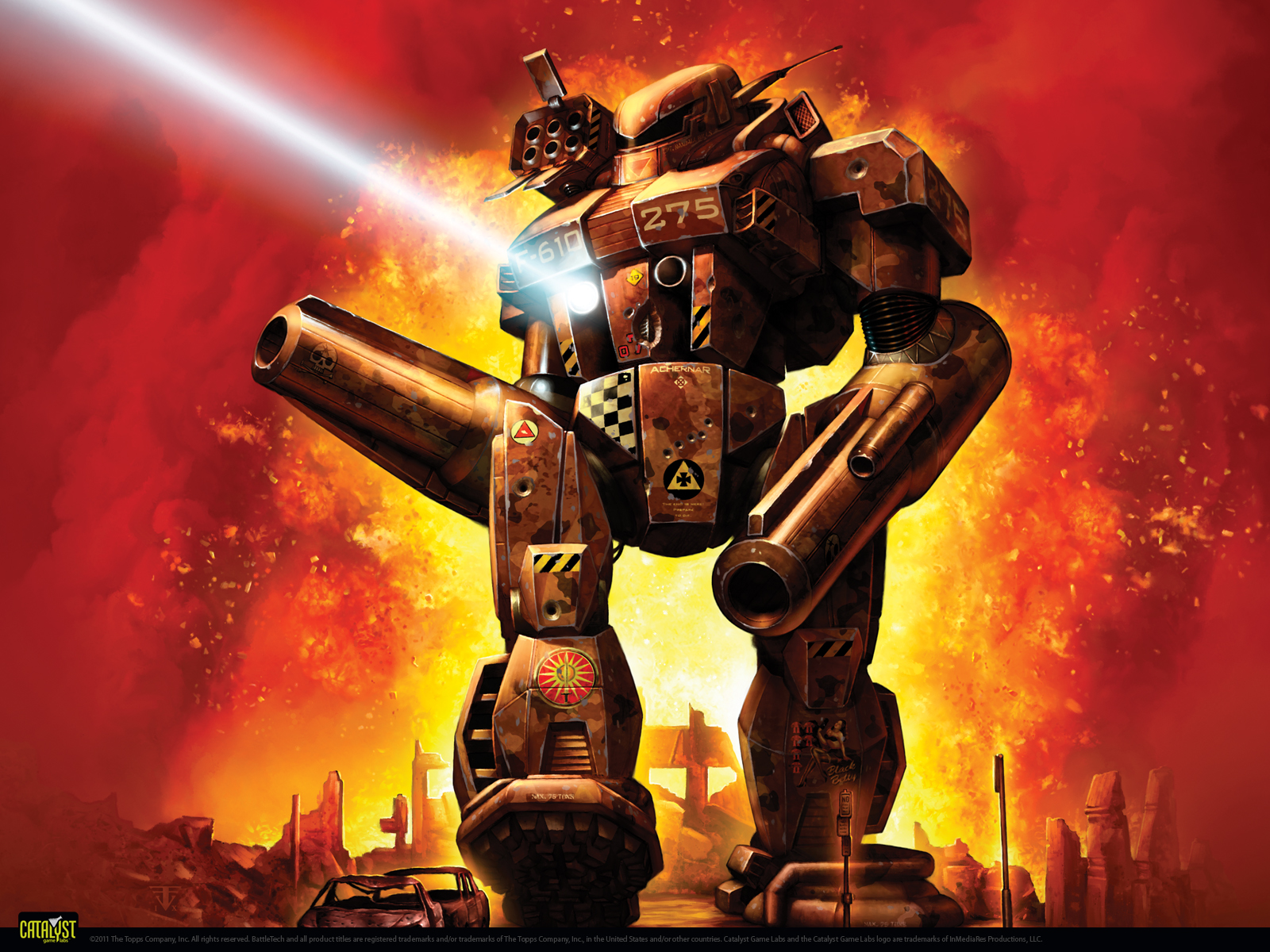
So first, the source:


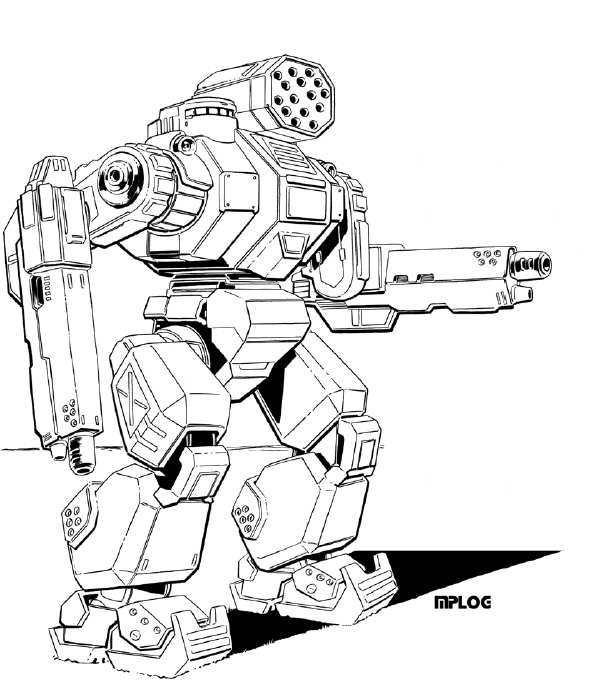
This 'Mech is a Thor II from BattleTech Technical Readout 3145: Clans.  It was originally based of a miniature from MechWarrior Dark age, and then adapted to BattleTech just a few months ago.  There is no current BattleTech scale miniature of this machine, so I hope to model it and then submit it.  Let's see how it goes!

As you can see, this 'Mech has almost no curvy features beyond a simple circle here and there.  Everything is very geometric with lots of flat sides.  This is good, as it fits my CAD style quite nicely.  I am not good with the curvy features, and will probably never model something with such until I get a bit more training.

I am going to start with the center torso.  Most ‘Mechs from the BattleTech universe are divided into several parts: Center Torso, Side Torsos, Arms, Legs.  You will see this model (and most of the art) follow the same format, which makes logical points to design a model off of.  Starting in the center also creates a good point from which to build all of the features.
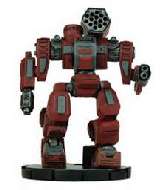
Now I am going to be extremely detail oriented in this model, and I hope to submit it to be made into a miniature, so every line, bump, or small detail you see in that image above will most likely be making it onto the model.  I also will be drawing some details form the original MechWarrior Dark Age miniature, seen below.


For modeling, I use Autodesk Inventor.  It is a relatively powerful CAD program, though not as powerful as some, such as CATIA or Unigraphics.  I originally learned on CATIA, but due to the high cost of owning even a student version, I haven't used it outside of a work or school environment.  Inventor is free for anyone with a .edu email address, and seeing that I am a masters student, it is an excellent opportunity to use this awesome and free software.  Even better, when I am done with school, I have the option of purchasing a perpetual license for the software for around $150, which is a steal.

Enough with the details, lets get down the the model!

Let’s begin:

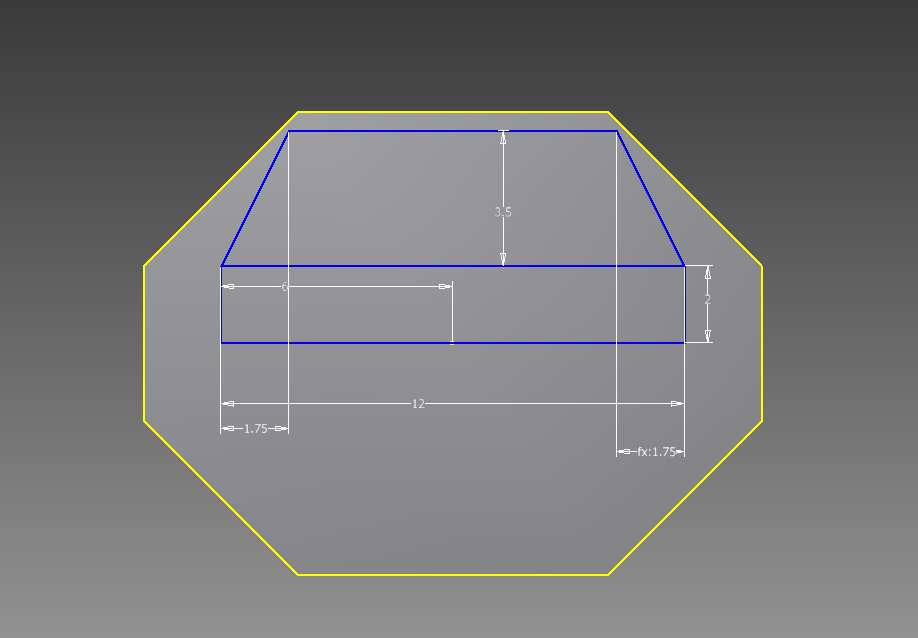
First, I start out with a simple trapezoid.  The center torso gives me the feeling it is a simple octagon, but I will be making half of it then mirroring it.  To simplify the process.
The basic sketch includes some basic, arbitrary measurements, but they serve for proportions.  Final measurements will be scaled up or down from these measurements.


Now I extrude it.  I make it a bit less than half the overall length.


And now I mirror it to make the full octagon.


Looking at this image and comparing it to the center of the original image shows me the shape is too wide and the center flat part is not tall enough.  Let’s adjust.


I doubled the height of the center flat bit, and that made everything seem more proportioned.  It is not perfect, but it is a solid start.  I may need to bump up the width later, or make further adjustments.  We’ll see.

Now, I am going to make one of the side torsos.  There is no point in making both of them because they are both symmetrical.  It really smoothes out the design when I can mirror almost any detail over to the other side.  The only thing that can’t be done via mirror is the top missile launcher and the head, both of which are no big deal.  Moving on…

The side torsos take the same shape as the center, just smaller, so lets do it!

Here is the initial sketch:


And now the extrusion:


And the first mirror:


And the second mirror:


And we see that there are some things off with the model.  I am going to reduce some sizes.  The flat parts in the front are currently 4mm tall, I am going to reduce that to 3.  Same with the wide of the side torsos, also to 3 mm.  Lets see what it looks like after adjustment:


There, much better.

Now lets add some of that center torso detail.  I will be making most of the detail on the right side of things and then mirroring it to the left.  For most of the center stuff, I won’t need to do that.

So, I won’t post the gritty details, but lets see what we can do.


So I have added quite a few of the main details from the drawing onto my model.  This all in all took me about half an hour to do, but it overall shows that the details can be added in a 
simple fashion.  There were also a few mirrors involved, mainly with the end-caps (I don’t 
know what else to call them) on the left and right torsos.

Now I will move onto the “Shoulders”, if they can be called that.  These present an interesting challenge because of their various details, such as the “cowl” on the upper part of the shoulder or the pattern of gaps on the arms also.

Once the shoulders are in place, I can also create the lasers on top of the shoulders and the details below them. 

It is of important note that this whole process took me a little more than an hour and a quarter, including taking the screenshots and writing this up.

But that will be for next time…

Friday, July 5, 2013

An Introduction to an Obsession of Mine


So, I have a nerdy hobby.  Well, I have several, but this is my nerdiest. Battletech.  Or, for people who may have played the computer games, MechWarrior.  This obsession/hobby (lately, it has been a hobby, but it has been an obsession in the past) has taken countless hours of my time over the last few years, and has peaked my interests since I was very young.  This will be my first post regarding BattleTech, but it certainly will not be my last.  This post focuses on the universe and board game, and I will be talking about miniatures, pc games, and more at future dates.

For those of you who do not know what BattleTech/MechWarrior is, here is a quick intro.  Big, stompy, robots.  It is a fictional universe where all wars are fought with 40ft tall walking tanks that can have up or more than a dozen different weapon systems.

The Mad Cat, once of the most recognizable Mechs


Okay, it is cooler than it sounds.  Just check out some of the awesome BattleTech art that is out there.  Or checkout MechWarrior Online, a free-to-play game based in the BattleTech universe.  There have been over a dozen PC games based on the universe and a huge number of novels, sourcebooks, and, of course, the original board game.

Now this is no ordinary board game.  It is probably one of the most complicated board games I have ever played, along with about 99% of the US population.  Basic rules are available online, but they do not cover nearly half of what the game has to offer.  But I will attempt to explain the game. 

BattleTech is played on a hex-based map system and is played with 2 or more players controlling 1 or more BattleMechs each.  Each mech can walk, run, jump, shoot, punch, kick, among other things, and the game play options are boundless.  Players play the game in multiple phases, and 4 or 5 phases make up a turn. Each player has a single record sheet for each mech they are using, and some assorted tables to help out with anything from movement to dice rolls.  Each turn begins with a movement phase where both players move their mechs.  Then comes the weapons firing phase, where each player designates which weapons are going to be fired at which enemies on the board.  Weapons use dice for probabilities to hit, and aspects such as movement, range, and individual weapons affect which numbers are needed on the dice.  When the weapons fire is all designated, damage is allocated.  Every mech is divided into several sections, 2 legs, 2 arms, 2 side torsos (with corresponding rear torsos), a center torso (also with a rear section) and the head.  Within each section is the critical equipment, the engine, weapons, explosive ammunition, to name a few.  A mech is destroyed if the head or cockpit is destroyed, the engine or center torso is destroyed, and pretty much if both legs are gone (but some players can decide to play on with a mech with no legs).  After armor is damaged and equipment damage is taken care of, players have the option of physical attacks.  These come in the form of punches, kicks, tackles, and swinging clubs.  Once that is done, the last step is heat, and this is where BattleTech is truly unique.  Each weapon generates a certain amount of heat.  So does walking or running.  Mechs have a certain ability to dissipate heat, but it is rarely enough to handle everything the mech can do.  So, when heat gets too high, your mech can’t move as fast, or shoot as accurately, and may even shutdown.  If you let the heat get way too high, it will cook off your ammunition and send the mech exploding into the air.  Once heat is taken care of, a turn is complete, and you repeat the process until your win or lose.

The Board Game being Played


It sounds tedious, but it can be a lot of fun.  I haven’t had many opportunities to play, but I have played at least half a dozen times with my cousin Jeff or my best friend Mike.

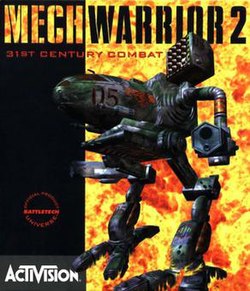
I have been interested in Battletech for a long time, ever since the early 90s when my dad put an old game called MegaTron on our computer.  The game used two mechs, one called a Mad Cat and the other a Vulture.  You would walk around in a maze and try and kill each other.  It was a dumb game, but the mechs were cool.  Then, we (as in my brothers and I) got a glimpse of an awesome game, Mechwarrior 2.  We had a full copy of the game, but it had an issue.  It was designed for a Matrox Mystique graphics card, which we did not have.  So, we could look at the mechs and read about the history and equipment of the BattleTech Universe, but we couldn’t play the game.  But my elder brother and I saw that same Mad Cat and Vulture, and they were still really cool.


Then we hit a hiatus.  With no access to MechWarrior 2, and no other exposure to battletech, my brother and I forgot about it.  We didn't really come back to it until probably the year 2000-2001.  We started looking at Mechwarrior 2 again and started wishing to be able to play a Mech game.  Then, one fateful day, my Dad came home with a brand new copy of MechWarrior 4: Vengeance.  It was amazing.  We already had a good joystick, and it was just a ton of fun, driving our 40ft tall, 100 Ton death machines.  My favorite mechs always were the Shadow Cat and the Daishi (or Dire Wolf, the cooler name),   while Andy always liked the Mad Cat Mk II and Brad liked the Cougar


MechWarrior 4 was a great game.  I must have played each version of it (Vengeance, Black Knight, and Mercenaries) about 6-8 times each (over a 12 year period, mind you).  Now, in the back of the Vengeance manual there was an advertisement for the metal miniatures, which got me thinking, I would love to own some of the mechs that I saw in those games.  But I never looked into it further. 

Then, in 2002ish, I saw an ad in the back of the MechWarrior 4: Mercenaries for the MechWarrior Dark Age miniatures game.  I decided I wanted it, got all my money I had, and I bought it.  It was quite fun, and I had 5 or 6 mechs, and a bunch of tanks and infantry.  My brothers and I would play every once and a while, and it was a good time.  Our interests died down, and I didn’t pay much attention to battletech again for a while.

I bought the premier set, it was awesome.


Then 2009 hit.  2009 was the 25th anniversary of BattleTech, and Piranha Games just announced a new MechWarrior title, and it had a sweet trailer.  Around the same time, I started to frequent sarna.net, the BattleTech wiki page.  And, I purchased the first 3 novels for BattleTech, the Grey Death trilogy.  After that, I borrowed some more books from my cousin Jeff, and I have been on and off reading novels ever since. 

In December of ’11, I finished my descent into nerdiness, I bought one of those miniatures I talked about earlier.  Then, I had so much fun painting it, I bought 3 more.  

My First 4 Miniatures.  Beginning of the End.


And they are fun to paint.  So then, I bought the introductory box set, which came with another 26 miniatures, and I have slowly been buying other products and other miniatures.  My interests in it have slowed down lately, but as history would have it, I’ll probably pick it up again, drop it again.  I still keep an eye on the BattleTech forums to see what people are painting or what new products are coming out, and I play a bit of MechWarrior Online from time to time, though I don’t spend any money because it is a bit too pricey for me. I have also since went back and bought MechWarrior 2, and it was an awesome game.  A lot of fun.

It is a very fun hobby, and it has taught me a life lesson.  Nerdy things are fun.  I mean, why else are people interested? I have never been much into sports or politics or pop culture, but nerdy things, them I do.  And they are just toys for big kids, and I have a good time.